Vessels
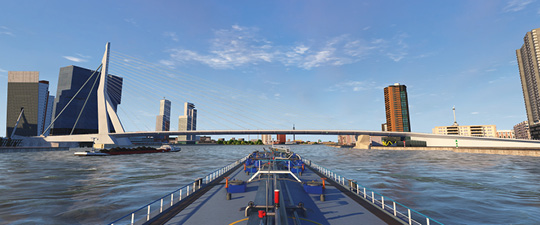
About the Simulator VesselsShip Simulator Professional contains a wide variety of ships and environments to train with. Below you will find an overview of the vessels that are included in the simulator. For customers requiring their specific vessels in the simulator, VSTEP can provide customised versions of Ship Simulator Professional featuring an accurate high quality visual representation of your fleet for training use. |
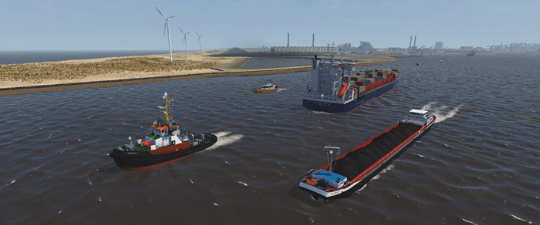
Azimuth Thruster Modern Tugboat
Fast Ferry Screenshot136Screenshot137 | The Fast Ferry is based on the Red Funnel high speed flagship, Red Jet 4. Built in Hobart, Tasmania, Red Jet 4 is the only vessel Red Funnel has built outside the UK and offers a big step forward in terms of ride comfort, speed and low-wash. Anti-vibration mountings separate the hull from the cabin to reduce noise and vibration, whilst vertical interceptors lift the aft section of the hull when deployed at speed to reduce wash. The Red Jet 4 is the fastest commercial passenger catamaran currently in the Solent. | View the technical specifications View a render of the ship |
Frigate Karel Doorman Class (M-Class) Screenshot139Screenshot140 | The Hr. Ms. Karel Doorman, named after famous Dutch naval officer Karel Doorman, is the first new multi-purpose frigate build for the Royal Netherlands Navy in a series of eight new multi-purpose frigates. The class is also knows as the multi-purpose or M-class. These frigates can be used in anti-submarine, anti-aircraft or surface combat roles. The Karel Doorman Class frigates were built by the De Schelde Group in Flushing strating in 1984 and have been operational since 1996. The eight ships of the class are: Karel Doorman (F827), commissioned 1991, Willem Van Der Zaan (F829), 1991, Tjerk Hiddes (F830), 1992, Van Amstel (F831), 1993, Abraham Van Der Hulst (F832), 1993, Van Nes (F833), 1994, Van Galen (F834), 1994 and Van Spejk (F828), 1995. | View the technical specifications View a render of the ship |
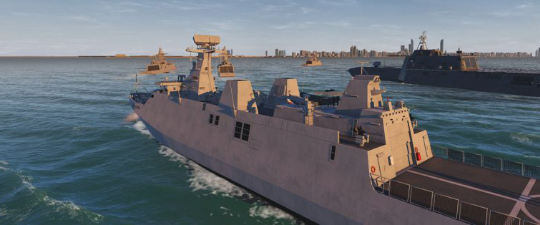
Frigate La Fayette Class Screenshot142Screenshot143 | The French Navy La Fayette Classe are light multi-purpose stealth frigates developed by DCN International (now DCNS) and constructed at the Lorient Naval Dockyard. This vessel in Ship Simulator Professional is based on the Sawari II programme witch included three Al Riyadh (F3000S) Class multi-purpose anti-warefare frigates built by DCN of France for the Royal Saudi Naval Forces. The frigates are 25% larger then the La Fayette Class frigate and containenhanced anti-air warfare and anti-submarine capability to meet the operational standards of the Royal Saudi Naval Forces. | View the technical specifications View a render of the ship |
Harbor Tug Screenshot145Screenshot146 | A tugboat is a vessel used to maneuver other vessels in harbors, over the open sea or through rivers and canals. They are also used to tow barges, disabled ships, or other equipment and are quite strong for their size.Historically tugboats were the first seagoing vessels to receive steam propulsion, freedom from the restraint of the wind, and capability of going in any direction. As such, they were employed in harbors to assist ships in docking and departure. Nowadays diesel engines are used. The engines are often the same as those used in railroad locomotives, but typically drive the propeller mechanically instead of converting the engine output to power electric motors, as is common for railroad engines. | View the technical specifications View a render of the ship |
Historical Ocean Liner (Titanic)
Historical Yacht Screenshot151Screenshot152 | In the 1930’s, established businessmen bought yachts of this kind in particulars to sail the Mediterranean coasts of Italy and France. This type of yacht was not designed for long sea voyages, but served as luxurious accomodation in mundane ports. Nowadays, like its oldtimer counterparts on wheels, these historic yachts are often real collector’s items. Since the level of luxury on larger yachts has seen an increasing trend, the use of the word yacht to mean any sailing vessel has been diminishing and is more and more limited to racing yachts or cruising yachts. | View the technical specifications View a render of the ship |
Hovercraft Screenshot154Screenshot155 | The AP1-88 was developed jointly by British manufacturer Hoverwork, BHC (British Hovercraft Corporation) and the NRDC (National Research Development Council) from 1981. Conceived in the early 1980’s out of a Hovertravel requirement for a larger more robust Hovercraft which possessed improved environmental characteristics relative to the then widely used SRN6. This type of craft can be configured as passenger transportation, combined passenger and freight, and freighter with open or closed deck area. | View the technical specifications View a render of the ship |
KNRM Rescue Boat Screenshot157Screenshot158 | This model is based on a class of rescue boats in service with the KNRM (Koninklijke Nederlandse Redding Maatschappij - Royal Dutch Rescue Company) consisting of modern rigidhulled inflatable boats (RIB). The RIB is a development of the inflatable boat which has a rigid floor and solid hull. The external shape of the hull lets it cut through waves more easily giving a more comfortable ride when travelling fast in rough conditions. The structure of the hull is capable of supporting a more powerful transom mounted outboard engine or even an inboard engine. | View the technical specifications View a render of the ship |
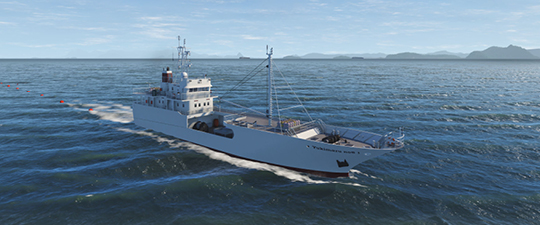
Kotter Class Fishing Vessel Screenshot160Screenshot161 | This small vessel of the Kotter model is used in the North Sea and the North Atlantic. With a crew of approx. 13 the ship remains several weeks on the sea before returning with a full load of fish. These boats are often specifically created to catch swarm fish like herring. There are many different kinds of fishing vessels used in both commercial fishing and in recreational fishing. Prior to the 1950’s there was little standardisation of fishing boats. Designs could vary between ports and boatyards. There are an estimated 4.2 million commercial fishing vessels worldwide. | View the technical specifications View a render of the ship |
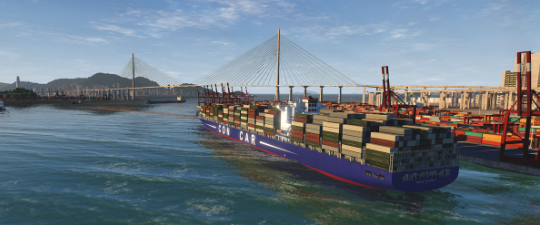
Large Container Vessel Screenshot163Screenshot164 | This Ship Simulator Profesional model is based on the existing large container vessels that form a common means of commercial intermodal freight transport. Container ships are designed as cost effective as possible and it is imperative that no space is wasted in its design. Above a certain size, container ships do not carry their own loading gear, so loading and unloading can only be done at ports with the necessary cranes. However, smaller container ships are often equipped with their own cranes for unloading. | View the technical specifications View a render of the ship |
Large Heavy Lift Ship Screenshot166Screenshot167 | This model is a multi-purpose freighter based on the small heavy lift freighters of this type that are used worldwide and transport the most versatile goods. With agility and versatility as its biggest trademarks, the ship can quickly load and unload its cargo with the help of the onboard heavy lift cranes, even in smaller ports. The ship is outfitted with two heavy lift cranes of 120 mt. WLL which can lift in combined (tandem) mode a total weight of 240 mt. | View the technical specifications View a render of the ship |
Minesweeper Sandown Class Screenshot169Screenshot170 | Originally build for the Britisch Royal Navy the Sandown Class is a class of minehunters. The first minehunter commissioned into the service of the Britisch Royal Navy on June 9, 1989. All named after britisch coastal towns and cities. Sandown Class minehunters are built with non-magnetic materials and designed to resist high shock levels. By using the Ship Position Contril System (SPCS) developed by Vosper Thornycroft, their manoeuvrability is controlled, either manually or automatically. These vessels also serve with the Royal Saudi Navy Forces under the Al Yamamah programme, commissioning in 1991-97 and the Estonian Navy. | View the technical specifications View a render of the ship |
Multi-product replenishment Durance Class Screenshot172Screenshot173 | This warship was originally build for the French Royal Navy and categorized in the series of multi-product replenishment oilers. The French Royal Navy is owner of five Durance class vessels: Durance (A629), Meuse (A607), Var (A608), Marne (A630) and Somme (A631). A single ship of the class was build for Australian Royal navy, the HMAS Success ( AOR 304). This Ship Simulator Pro model, the Durance, was the leading ship of the class and sold to the Argentine Navy in 1999. Nowadays the vessel serves under the name of Patagonia. The remaining four vessels serve as flagships. | View the technical specifications View a render of the ship |
Multi-purpose freighter Screenshot175Screenshot176 | The multi-purpose freighter is based on the small heavy lift freighters of this type that are used worldwide and transport the most versatile goods. With agility and versatility as its biggest trademarks, the multi-purpose freighter loads and unloads its cargo with the help of the onboard heavy lift cranes, even in smaller ports. A very high service speed in relation to a low fuel oil consumption is reached. For improved navigation-visibility with high deck cargoes, a camera is mounted in the foremast, and a special additional navigation stand is situated on the forecastle deck. | View the technical specifications View a render of the ship |
Natural Gas Platform Screenshot178Screenshot179 | An oil platform is an offshore platform often referred to as an oil rig. The platform may be fixed to the ocean floor, may float or consist of an artificial island. Due to advances in technology, the production in deeper waters has become more profitable. Before, most offshore platforms where located on the continental shelf. This platform is the home of workers and machinery needed to extract oil and/or natural gas, process the fluids and ship or pipe them to the shore. | View the technical specifications View a render of the ship |
P1 - Powerboat Screenshot181Screenshot182 | This high performance powerboat is powered by two 525HP engines. The high power to weight ratio and and a hull design that allows for easy planing allows for higher speed and improved handling. It allows the power boat to reach top speeds of 85 knots (157 km/hr) and gives it improved handling. There are different types of powerboats. The cream of the crop are the F1 Powerboat. These are tunnel hull catamarans that are capable of both high speed and exceptional maneuverability. The tunnel hull design creates an air cushion under the hull, so that at speed only a few inches touch the water, leading to the high speed possible with these hulls. | View the technical specifications View a render of the ship |
P6 - Harbor Patrol Boat Screenshot184Screenshot185 | This new asset to the fleet of the Dutch Zeehavenpolitie (harbor police) patrols the harbor of Rotterdam and is also used by New York authorities. The vessel has very powerful engines to catch up with ships that might want to flee. The P6 is a custom designed ship for the harbor of Rotterdam. It is equipped with a lot of hightech equipment and is a multi-purpose vessel used for a wide range of policing activities.
| View the technical specifications View a render of the ship |
Pilot Boat Screenshot187Screenshot188 | A harbor pilot is an experienced pilot whose task it is to guide other vessels and help them to navigate through coastal waters between a harbor and the open sea. Harbor pilots carry great responsibility. The harbor pilot joins an incoming ship at sea via a pilot boat and climbs up to the deck of the ship that has to be guided. With outgoing vessels, the opposite occurs, and a pilot boat returns the pilot to land after the ship has successfully negotiated coastal waters and is ready to enter open sea. | View the technical specifications View a render of the ship |
Pushboat (Towboat) Screenshot190Screenshot191 | Pushboats are typical for domestic river services especially in Europe, but also overseas. They are characterized by a square bow with steel knees for pushing and by hosting powerful engines. They are most often seen on inland waterways and rivers. A pushboat typically pushes very large cargo barges. In the United States, you can find pushboats (called “Towboats” in the U.S.) pushing more than 50 large barges lashed together into a tow of varying shapes and sizes. | View the technical specifications View a render of the ship |
Raptor Class Passenger & Car Ferry Screenshot193Screenshot194 | The Raptor Class Car Ferry is built for ‘The Southampton, Isle of Wight and South of England Royal Mail Steam Packet Co. Limited’. This company, formed in 1861, holds the record for the longest name for a registered company in the UK. The shortened company name ‘Red Funnel’ was adopted after 1935 when all vessels operated by the company adopted the black-topped red funnel in their livery. Red Eagle was built in 1996 by Ferguson Shipbuilders in Port Glasgow for the Southampton-East Cowes (Isle of Wight) car ferry service. | View the technical specifications View a render of the ship |
Rigid Inflatable boat Screenshot196Screenshot197 | The RIB is a development of the inflatable boat. It\'s a lightweight boat with a high performance and a high capacity. The hull is solid shaped and there are flexible tubes at the gunwale. If you require a boat that provides a sense of security and wellbeing, excellent performance, handling and incredible versatility, then there is no better craft than a Rigid Inflatable Boat. Ribs are highly regarded as one of the safest ways of transporting people and equipment over short or long distances at sea in the most challenging of conditions. | View the technical specifications View a render of the ship |
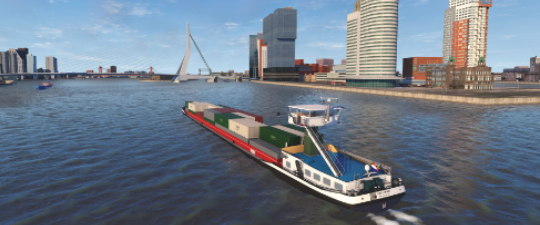
River Boat Container Vessel Screenshot199Screenshot200 | These vessels are designed for inland navigation. River boats are carry passengers and cargo along the course of the river. Unlike open sea vessels these ships have limited navigational and rescue equipment, this because extreme situations as seen on seas and oceans do not occur within rivers. To decrease 50% of the weight the ship it\'s made of composite materials instead of steel. This also results in a decrease of energy requirements. | View the technical specifications View a render of the ship |
RPA Patrol & Incident response vessel Screenshot202Screenshot203 | This vessel is specially equipped for patrol, inspection, fire-fighting, and pollution controlduties throughout the Rotterdam port area. A round bilge hull design was strengthened where necessary with a combined longitudinal and transverse framing system. The hull form, twin-screw propulsion system, powerful bow thruster and highlift rudders, give exceptional handling characteristics at all speeds. The fire-fighting system aboard is powered by two Caterpillar 3406 diesels driving Nijhuis fire pumps eachsupplying 900m3 of water per hour. Four powerful remotelyoperated fire monitors are fitted. The fire-fighting system iscapable of delivering water or foam with all monitors operatingsimultaneously. | View the technical specifications View a render of the ship |
Russian Tugboat Screenshot205Screenshot206 | The last tugs of this conventionally shaft propelled type are used for small tow jobs on rivers and in ports. Because of their durable construction, these tugs are suitable for employment in ice environments. Tugboats are highly maneuverable, and various propulsion systems have been developed through the years to increase maneuverability and safety. Harbor tugs are the most typical of the tugboats and are used worldwide to move ships in and out of berth and to move industrial barges around waterfront business complexes. Their job has remained the same, but their design andengineering has changed much over the decades. Harbor tugs have evolved from paddle wheelers to the conventional wellknown tug, and now to the Ship Docking Moduals and tractor tugs in the modern industry. | View the technical specifications View a render of the ship |
Seagoing Steamtugboat Screenshot211Screenshot212 | The primary propulsion of the steamtugboat is steampower, typically driving propellers or paddlewheels. Often these vessels carry a ship prefix for their name, "SS" stands for \'Steam Ship\' and given to screw-driven steamtugboats, paddle steamers usually carry the prefix "PS". In 1819 the first steamtugboat steamtugboat crossed the atlantic ocean. During the 19th century steamships gradually replaced sailing ships for commercial shipping. | View the technical specifications View a render of the ship |
Speed Yacht Screenshot214Screenshot215 | The speed yacht is a luxury yacht. The high speed makes it possible to sail long distances while the comfortable salon accommodates a longer stay. The beauty of these luxury yachts lies in their features. For luxury yachts like these, the hull has been built to withstand all conditions, and they can operate in all common regions, from the Mediterranean to the North Sea. A central heating system and air conditioning system provides the perfect temperature inside. Other features include satellite phone, internet access, surround sound and video system throughout and a central vacuum system. | View the technical specifications View a render of the ship |
Supertanker Screenshot217Screenshot218 | Supertankers are capable of transporting vast quantities of liquids and in practice are used to move crude oil. Also known as a VLCC (Very-Large-Crude-Carrier), the supertanker is amongst the world’s largest ships capable of transporting 2 to 3 million barrels of oil. Because of their great size, supertankers often can’t enter ports fully loaded. These ships take on their cargo at off-shore platforms and single-point moorings. On the other end of the journey, they pump their cargo off to smaller tankers at designated lightering points off-coast. A supertanker’s routes are long, requiring it to stay at sea for extended periods. | View the technical specifications View a render of the ship |
Water taxi Screenshot220Screenshot221 | This small light-weight water taxi is the fastest means of public transport available in the Harbour. The taxi service shuttles people throughout the Harbour, stopping at designated pick-up points. Water taxi services are provided in most harbours. In Rotterdam, the water taxi can easily be used as additional means of public transportation. The terms water bus and water taxi are roughly synonymous, whilst elsewhere the term water taxi is usually confined to a boat operating on demand, and water bus to a boat operating on a schedule. | View the technical specifications View a render of the ship |
|